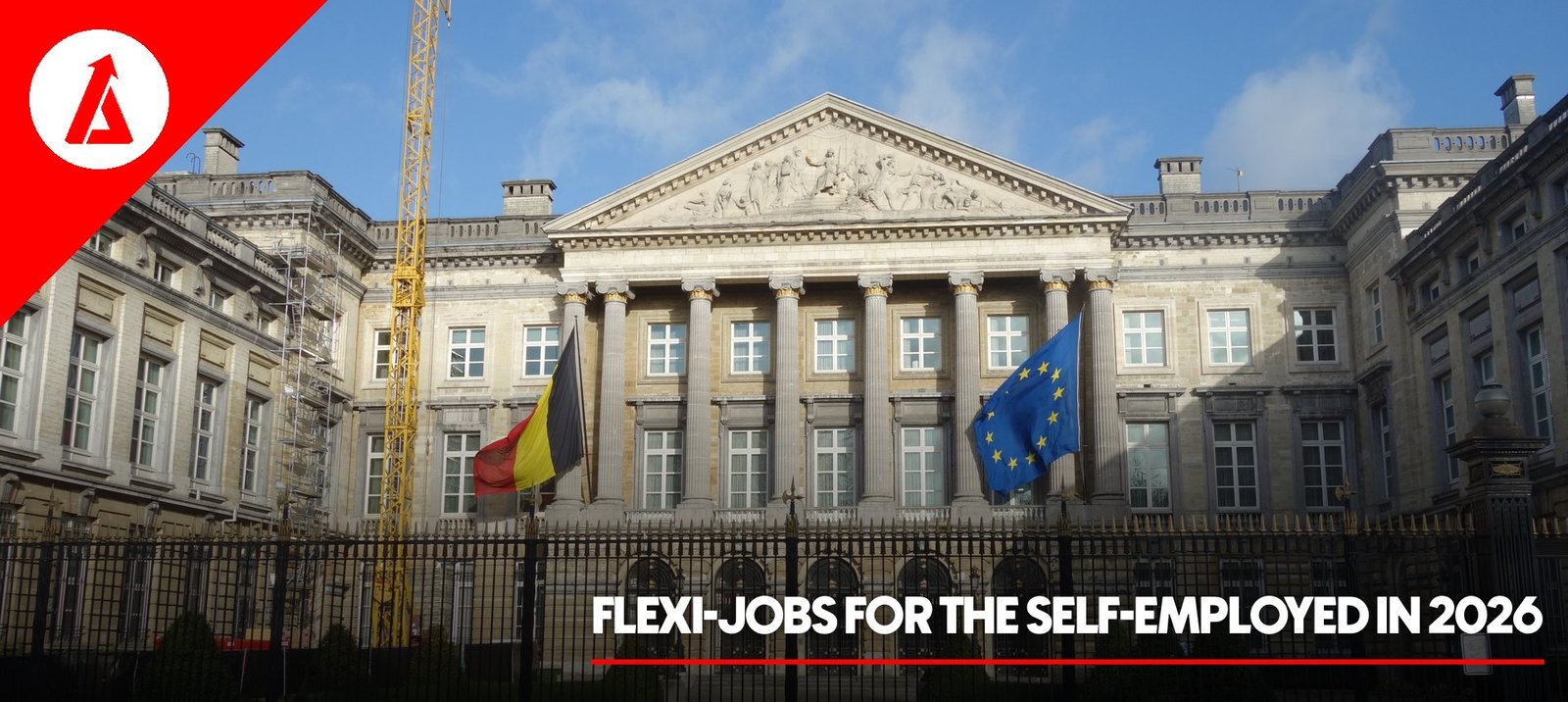
Flexi-jobs for self-employed workers in 2026: what the proposal on the table would actually mean
Today, self-employed people working as their main occupation cannot take a flexi-job. Minister for the Self-Employed and SMEs Eléonore Simonet wants to change that and has put forward a proposal to open the flexi-job system to self-employed people in their main occupation and to assisting spouses. The General Management Committee for the social status of the self-employed gave a favourable signal in its opinion 2026/08, with a ceiling of 480 hours per year and a set of conditions. The file lands on the table of the federal budget talks this autumn. In this article you will read what is being proposed, who it would apply to, what the current flexi rules are and why not everyone is enthusiastic.
What is on the table
The proposal removes one specific barrier. Anyone who is self-employed as their main occupation falls outside the flexi-job system today. As a self-employed person you can hire a flexi-jobber, but you cannot become one. In practice, a business manager, a freelancer or a craftsperson who wants to help out a few evenings in a hospitality venue or a shop during a quiet spell can only do so through an ordinary employment contract or by invoicing.
The reasoning behind the proposal is simple. Self-employed income fluctuates. A seasonal business, an assignment that falls through, a winter without work: in those periods a flexi-job would be a way to top up income without shutting down your own activity. The flexi-job explicitly remains a supplementary activity, not a replacement for the main occupation.
The opinion of the General Management Committee is an opinion, not a law. The concrete implementation depends on the federal budget talks and on a bill that still has to pass parliament afterwards. So there is no date yet on which a self-employed person can accept a flexi-shift.
Who it would apply to
According to the opinion, the scheme would be limited to self-employed people in their main occupation and to assisting spouses. Self-employed people with a secondary occupation are therefore excluded, as are student entrepreneurs and retired self-employed people. That makes sense: someone working in a secondary occupation usually already has a main activity as an employee and can often already take a flexi-job through the ordinary route.
The line between a secondary self-employed activity and a flexi-job is not obvious to everyone. The difference is the status: in a flexi-job you are an employee with an employment contract, in a secondary activity you work for your own account and invoice yourself. We put the three ways of earning extra side by side in our blog on side hustle, secondary occupation and flexi-job: anyshift.be.
The conditions on the table
The opinion lists four conditions that open the door while preventing abuse.
- Affiliation. You must be affiliated with a social insurance fund for the self-employed and registered in the Crossroads Bank for Enterprises.
- Contributions paid. Your social contributions as a self-employed person must have been paid correctly in the third quarter before the flexi-job, the so-called T-3 rule. That is the same logic as for employees, who must have worked at least four fifths in T-3.
- Hours ceiling. A maximum of 480 hours per calendar year in a flexi-job. That is roughly 60 days of eight hours, or one evening shift a week plus part of the weekend.
- Not in your own company. You cannot take a flexi-job in your own company or in a linked enterprise. This prevents a manager from paying themselves more cheaply through a flexi contract.
In addition, the existing verification application would have to be adapted so that an employer can check in advance whether a candidate meets all the requirements. That check already exists for employees today through the flexi desk.
What does not change: today's flexi rules
If the proposal becomes law, the same rules will apply to the self-employed as to every other flexi-jobber. Those rules were extended to all sectors on 1 July 2026, with an opt-out mechanism allowing sectors to exclude flexi-jobs or impose additional rules. You can read more about that in our blog on flexi-jobs in all sectors: anyshift.be.
Concretely for 2026: you earn up to 18,440 euros a year free of taxes and social contributions. In hospitality the minimum flexi wage is 12.11 euros gross per hour, plus 0.93 euros flexi holiday pay, for a total of 13.04 euros gross per hour. That gross figure is also your net. Flexi holiday pay amounts to 7.67 percent of your flexi wage and is paid out with every shift. The employer in turn pays a special contribution of 28 percent. All amounts and rules are in our blog on the flexi-job hourly wage in 2026: anyshift.be.
The 480-hour ceiling is new and would apply only to the self-employed. Ordinary flexi-jobbers have no hours ceiling, only the tax ceiling of 18,440 euros.
The criticism: blurring lines and the bill
Not everyone is convinced. From the freelance world comes the concern that the line between employee and self-employed worker is blurring further. Jenny Björklöf of Freelancers in Belgium warns that flexi-jobs risk replacing regular jobs or freelance assignments. The reasoning: if a company can have a task done for a 28 percent contribution instead of through a freelance assignment or a permanent contract, the cheapest formula quickly becomes the standard.
Then there is the budget question. The flexi system cost social security an estimated 500 million euros in 2025, and that bill grows with every extension. That is precisely why the file ends up in the budget talks rather than as a standalone law. Anyone following the debate on extensions will find a comparable file taking the same route in our blog on the bill for flexi-jobs for the long-term ill: anyshift.be.
What it would mean for employers
For businesses that work with peaks, this is interesting news. Self-employed people in their main occupation are a group of hundreds of thousands with experience, their own business and often exactly the skills that hospitality, retail and events are looking for. A chef with their own catering business helping out on Saturdays, a graphic designer behind the bar at the weekend: those profiles are hard to bring in today.
Administratively, little changes. You still submit a Dimona of the FLX type and you pay the same special contribution. The difference with a temp worker also still holds, and we work out those figures in our blog on flexi-jobber versus temp worker: anyshift.be. Do you want to work with flexi-jobbers already? Take a look at our page for businesses: anyshift.be.
In practice: contract, Dimona and what you can already do
A flexi-job starts with a framework agreement between employer and flexi-jobber, and a flexi employment contract per shift, written or oral. The employer submits a Dimona FLX with the hours before the shift starts. Through AnyShift that happens automatically as soon as you accept a shift, and you immediately see what you keep net. How other shifters go about it, you can read on our page for shifters: anyshift.be.
Are you self-employed in your main occupation today? You cannot accept a flexi-shift yet. What you can already do: check whether your contributions are paid properly, because the T-3 condition looks back in time. Anyone with arrears in the fourth quarter of 2026 would not be able to take a flexi-job in the third quarter of 2027 if the scheme exists by then. All current flexi rules are on our flexi-jobs page: anyshift.be.
Five tips to be ready
- Keep track of your contributions. The T-3 condition is the most underestimated barrier. One unpaid quarter can exclude you a year later.
- Calculate your 480 hours in advance. That ceiling is tighter than the tax ceiling of 18,440 euros. In hospitality, 480 hours comes to around 6,260 euros gross.
- Pick a sector that fits your business. Experience in the same sector gets you better shifts and does not compete with your own clients, as long as you do not take clients with you.
- Check your sector. Since 1 July 2026 sectors can exclude or limit flexi-jobs through an opt-out. Check that before you plan.
- Set up your profile now. Whoever is available on day one of the scheme gets the first shifts.
Frequently asked questions about flexi-jobs for the self-employed
Can I take a flexi-job today as a self-employed person in my main occupation?
No. Self-employed people in their main occupation are currently excluded from the flexi system. The proposal to change that is on the table, but it is not yet law.
When would the scheme come into force?
There is no date. The file will be discussed in the federal budget talks this autumn and must then pass parliament as a bill.
How many hours would I be allowed to work?
The opinion mentions a maximum of 480 hours per calendar year. That ceiling comes on top of the 18,440-euro tax ceiling that applies to all flexi-jobbers.
Could I then take a flexi-job in my own company?
No. The proposal explicitly excludes your own company and linked enterprises.
Does this also apply to people with a secondary self-employed activity?
No. The scheme would be limited to self-employed people in their main occupation and to assisting spouses. Someone running a secondary activity alongside a salaried job can often already take a flexi-job under the ordinary conditions.
In summary
Minister Simonet's proposal would give self-employed people in their main occupation and assisting spouses access to flexi-jobs, with a ceiling of 480 hours a year, a T-3 condition on social contributions and a ban on working in your own company. The opinion is favourable, but the decision falls in the budget talks. Until then the current rules apply: 18,440 euros a year tax-free and a 28 percent contribution for the employer. Want to read more? Check our other blogs: anyshift.be or our frequently asked questions: anyshift.be. Are you an employer looking for flexi-jobbers? Find out what AnyShift does for businesses: anyshift.be.
📲 Ready to earn extra with flexi-shifts? Download the free AnyShift app from the App Store: apps.apple.com or Google Play: play.google.com.