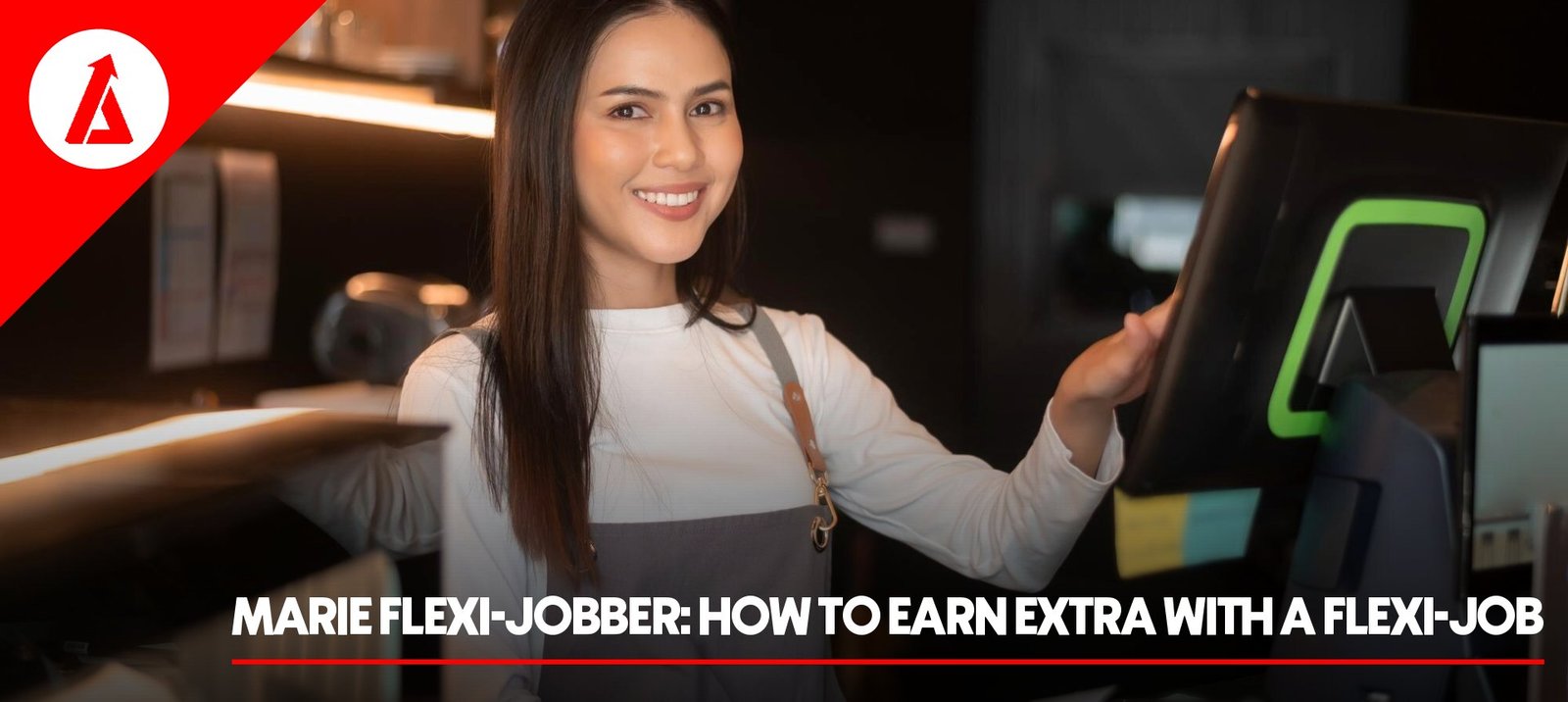
Marie flexi-jobber: how to earn extra with a flexi-job
A flexi-jobber like Marie earns extra by doing flexi-shifts for another employer alongside her main job. For this you need a main job of at least 4/5, or a pension, and an employer from a sector where flexi-jobs are allowed. Your flexi income is tax-free up to 18,440 euros per year (income year 2026), except if you are retired: then this ceiling does not apply.
You are probably looking for a story like Marie's, a flexi-jobber who tells how she earned extra. In this article we work with an imaginary example, without amounts, and explain what you need to arrange yourself to do the same.
How does a flexi-jobber like Marie earn extra?
Suppose Marie works full-time in an office. Her main job covers her fixed costs, but she wants a bit more room in her budget. So on Friday evenings and Saturdays she occasionally takes a flexi-job with an employer from an allowed sector. She chooses when she is available and agrees on the shifts with the employer.
This is how the extra income usually comes about. It is no coincidence and no trick, but a combination of three things:
- you meet the conditions for a flexi-job;
- you work regularly for an employer who knows you and whom you know;
- you know what you take home net and you keep the annual ceiling in mind.
Do you want to know what flexi-jobs look like in practice? On our page about flexi-jobs you will find an overview.
Who can do a flexi-job?
A flexi-job employment contract is an agreement under which you carry out an additional job for an employer. The condition: you are already employed by one or more other employers for at least 4/5 of a full-time job. This applies to people with a main job. Retirees can also do a flexi-job and earn extra.
The FOD WASO (the Belgian Federal Public Service for Employment) determines how you check that 4/5 employment. You look at a reference quarter, T-3. That is the third quarter before the quarter in which your flexi-job starts. An example from the FOD: if you start in July 2023 (third quarter of 2023), you must have worked at least 4/5 of a full-time job in the fourth quarter of 2022, so in October, November and December 2022.
In that calculation, the FOD counts all periods your employer paid for. In addition, a limited number of listed periods count in which your employment contract was suspended and you received no wages from your employer.
Are you a student without a main job? Then a flexi-job is usually not for you. For you there are student jobs, a separate system with its own rules.
In which sectors can you earn extra with a flexi-job?
The system started on 1 December 2015 in the hospitality sector. From 2018 it was extended several times to other sectors. Since 1 July 2026 it is in principle open to the entire private and public sector. That widens your choice: you no longer search only in a small group of sectors.
There are exceptions, though. Flexi-jobs are not allowed in these sectors:
- domestic work (household staff);
- funeral directors, with an exception for workers who carry out the activities of an occasional worker;
- agriculture;
- horticulture, except for the construction or maintenance of parks and gardens;
- sea fishing, except shore staff and warehouse staff. You may not work with flexi-jobbers at fish auctions.
There are also general exclusions for employment covered by the law of 3 May 2024 (sex work) and for artistic, artistic-technical and artistic-supporting roles. Sectors can also request an opt-out. In 2026 this is possible every quarter, from 2027 every year. Ask your employer whether the flexi-job in their sector applies to your role.
What stays tax-free from your flexi income?
Your flexi income is tax-free up to 18,440 euros per year (income year 2026). As long as you stay below that, your employer does not withhold payroll tax on your flexi wage. If you earn more than 18,440 euros of flexi wage in one year, everything above that amount is taxed.
That ceiling does not apply to retirees. If you are retired and want to know exactly what your situation means for your pension or tax return, check with the Federal Pension Service or the tax authorities.
There is also a financial advantage for your employer: for a flexi-jobber they pay only an employer contribution of 28%. That is one of the reasons why companies like to work with flexi-jobbers. For you as a flexi-jobber, this can help you get work more often.
How do you get more shifts and therefore more income?
Earning more comes down to getting more chances to work, and that does not depend only on the job itself. This works in practice:
- Be clear about your availability. An employer finds it easier to plan with someone who says in advance when they can work.
- Choose a place nearby. The shorter your commute, the easier it is to accept an extra shift. Check the locations for flexi-jobs and student jobs to see where vacancies are.
- Build a lasting relationship. Reliable people get asked back sooner.
- Work for more than one employer. This is possible, as long as you meet the conditions and the agreements with each employer are in order.
As a shifter, you can respond via the platform to shifts that suit you, without having to contact companies yourself every time.
What do you do with your main job or pension?
A flexi-job does not replace your main job, it comes on top of it. Your main job remains the basis on which your flexi-job rests, because it is how you meet the 4/5 condition. If you plan to reduce your hours in your main job, first look at the reference quarter T-3. That way you avoid no longer meeting the condition later on.
Are you retired? Then you do not need a main job to do a flexi-job, and the tax ceiling of 18,440 euros does not apply to you. Consult the competent authority if you have doubts about a personal situation.
Practical matters: framework agreement, contract and Dimona
The RSZ (the National Social Security Office) imposes a fixed procedure on your employer. For the first flexi-job, your employer concludes a written framework agreement with you. It includes, among other things:
- the identity of the employer and the employee;
- a short description of the role;
- the flexi wage;
- whether the flexi employment contract is oral or written, and within what period it is presented to you;
- the conditions you must meet to be allowed to do a flexi-job.
Your employer registers you via Dimona. This is done per quarter, and at most one month in advance. This type of Dimona also includes an attendance registration, so that the RSZ knows exactly when you work. Afterwards, your employer transfers your wage data via the online service Flexi at work to the flexi wage counter on mycareer.be.
For you as a flexi-jobber this means: ask your employer for the framework agreement, read it through and keep it. Employers who want to hire flexi-jobbers can find information on our page for companies.
Five tips to earn extra as a flexi-jobber
- Check your conditions first. See whether you reach 4/5 of a full-time job in the reference quarter T-3, or whether you are retired.
- Ask for the framework agreement. Without that agreement, your flexi-job cannot start.
- Keep track of your worked shifts yourself. Then you can compare them with what your employer registers.
- Keep an eye on the annual ceiling. Up to 18,440 euros per year (2026), your flexi income is tax-free. Above that amount you pay tax on the excess, unless you are retired.
- Check the sector. Make sure your employer is not in an excluded sector or has an opt-out.
Frequently asked questions about flexi-jobber Marie and earning extra
How much extra did Marie earn with her flexi-job?
That differs from person to person. It depends on how many shifts you do and for which employer. The only fixed figure is the tax ceiling: tax-free up to 18,440 euros per year (2026), not for retirees.
Can I do a flexi-job as a student?
Normally not. A flexi-job requires a main job of at least 4/5 or a pension. As a student, look at student jobs.
In which sectors may I do a flexi-job since 1 July 2026?
In principle in the entire private and public sector. Excluded are domestic work, the funeral sector, agriculture, horticulture and sea fishing, with a few exceptions. Sex work and artistic roles are also excluded.
What does my employer arrange and what do I have to do myself?
Your employer concludes the framework agreement, files the Dimona per quarter with attendance registration and transfers your wage data. You check whether you meet the conditions and read through your agreement.
In summary
A flexi-jobber like Marie earns extra by doing flexi-shifts for an employer in an allowed sector alongside a main job of at least 4/5 (or with a pension). Your flexi income is tax-free up to 18,440 euros per year in 2026, and that ceiling does not apply to retirees. Your employer arranges the framework agreement and the Dimona.
Do you want to get started? Check the vacancies for flexi-jobs, find a place via the locations or register as a shifter. If you are an employer, you will find information for companies. You can read more explanations on our blog.